What Magnification Does an Air Rifle Scope Need?
By Peter Makulek · Senior Optics Editor · · Live prices from UK retailers
Quick answer: for hunting with an air rifle in the UK, a 3-9x or 4-12x variable scope is the sweet spot. Keep the power low for ratting and close-range pest control, step up to 4-12x for rabbits and squirrels at 25 to 45 yards, and only move to 6-24x or 8-32x if you shoot field target or paper at known distances and want the extra resolution to range-find by parallax.
Magnification is the number most buyers fixate on, and it is the one that matters least for airgun hunting. A pellet from a sub-12 ft-lb rifle is a short-range projectile. Its effective, humane range on quarry is measured in tens of yards, not hundreds, so a scope that magnifies 32 times does not make the rifle any more capable. What it does do is magnify your own pulse, every wobble of the rifle and any heat haze, while narrowing the field of view so you lose the rabbit you were trying to find in the first place.
This guide explains how magnification interacts with field of view, exit pupil, parallax and reticle size, and gives you a clear rule of thumb for each kind of UK airgun shooting: farm and garden ratting, rabbit and squirrel control, pigeon and corvid work, and target and field target competition. Prices are in pounds and the picks below are live UK catalogue listings.
Top Picks — Live UK Prices
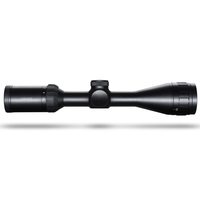
Hawke Airmax 3-9x40 AO Rifle Scope
via Uttings
£169.00

Hawke Airmax 4-12x40 AO AMX Rifle Scope
via Optics Warehouse
£187.99

Vector Optics VictOptics SOI 4-12×40 Air Rifle Scope
via Optics Warehouse
£59.99
Buying Advice
Start with what each number actually means. A 4-12x40 scope zooms from four times to twelve times magnification and has a 40 mm objective lens. Divide the objective by the magnification to get the exit pupil, the shaft of light that leaves the eyepiece: 40 mm at 10x gives 4 mm, while a 50 mm lens at 24x gives only about 2 mm. A bigger exit pupil is brighter and more forgiving of head position, which is why a modest 3-9x40 feels easy to use at dusk while a 6-24x50 wound all the way up can look dim and fussy. In bright daylight your own pupil is small enough that you rarely notice. At first and last light you very much do.
Field of view works the other way: the more you zoom, the less of the world you see. At 3x you can sweep a hedgerow and spot a rabbit sitting out on the margin. At 24x you are looking through a straw, and finding a moving squirrel in a tree takes a second or two longer than it should. For hunting, wind the power down to find the quarry, then add power only for the shot if you need it. A variable scope that lets you do that, with a clear window between roughly 3x and 12x, is far more useful than a high-power scope you leave on maximum.
Why not simply buy the highest power you can afford? Because pellet guns are shot at short, known ranges where parallax matters enormously. Higher magnification makes parallax error and mirage more obvious, gives a thinner depth of field, and demands a very steady hold. If you use a springer or a lightweight PCP off sticks or a rest in the field, extra magnification shows you precisely how much you are moving. In HFT and field target the logic changes: competitors use 6-24x or 8-32x with side-focus parallax wheels to estimate range from the focus setting, and they shoot from a stable seated or kneeling position. Check your league's rules before buying, as some limit power in certain classes.
Here is a practical guide by shooting type. Ratting around farm buildings, poultry units and gardens, where shots are often 5 to 25 yards, suits 3-9x or even 2-7x with a good close-focus adjustment. Rabbits, grey squirrels, pigeons and corvids at around 20 to 45 yards suit 3-9x or 4-12x; many experienced shooters hunt on 6x to 9x and rarely touch the rest of the dial. Field target and paper targets at known distances suit 6-24x or 8-32x, ideally with side focus. Keep your ranges honest: a sub-12 ft-lb rifle is a humane tool for roughly the first 40 to 50 yards on small quarry, and a high-power scope does not extend that. Look at the reticle too, because a fine reticle that looks perfect at 9x can cover a lot of a rabbit's head at 24x.
Reticles and focal planes add one more wrinkle. On a second focal plane (SFP) scope, which is what most airgun scopes are, the reticle stays the same apparent size as you zoom, so mil-dot or hold-over marks are only true at one power, usually the maximum. If you plan to hold over using the reticle, learn which setting your marks are calibrated for and shoot at that power. A first focal plane (FFP) scope scales the reticle with the image so the marks stay valid at every setting, at the cost of a thicker reticle at low power. For reference, 0.1 mil is 1 cm at 100 metres, and 1 MOA is about 1.047 inches at 100 yards. For airgun distances a simple duplex or mil-dot reticle on an SFP scope is perfectly fine.
On cost, the catalogue shows Hawke's Airmax range, a long-standing airgun favourite in the UK, spanning 2-7x32 and 3-9x40 models at the lower end through 4-12x40 and 4-12x50 scopes, with 30 mm tube Airmax 30 models carrying higher powers up to 8-32x50, at prices from around £160 to around £430 at the time of writing. Prices and stock change daily, so use the live picks above to see what is available now. Whatever you buy, make sure the scope is rated for springer recoil if you shoot a spring-piston rifle, and that its parallax adjustment reaches down to about 10 yards.
Frequently Asked Questions
What is the best magnification for an air rifle scope in the UK?
For general hunting and pest control, a 3-9x or 4-12x variable scope is the best all-rounder. It gives a wide field of view at low power for finding quarry and enough magnification for a clean head or chest shot at typical airgun ranges of 15 to 45 yards.
Is 6-24x too much magnification for an air rifle?
Not for field target or paper shooting, where 6-24x with a side-focus parallax wheel is common. For hunting it is usually more than you need, because the narrow field of view makes finding moving quarry slower and every small movement of the rifle is magnified.
Does higher magnification increase the range of an air rifle?
No. Magnification only makes the target look bigger. It does not change the pellet's velocity, energy or trajectory. A sub-12 ft-lb air rifle remains a short-range tool, and you should still limit shots on live quarry to distances at which you can place the pellet reliably and humanely.
What does the second number in 3-9x40 mean?
The 40 is the diameter of the objective lens in millimetres. A larger objective lets in more light and gives a bigger exit pupil, which helps at dawn and dusk, but it also makes the scope heavier and means you need taller rings to clear the barrel and any breech.
Should I buy a fixed 4x32 or a variable scope?
A fixed 4x32 is simple, light and cheap, and is fine for casual plinking at short range. A variable scope costs more but lets you drop to a wide view for finding quarry and zoom in for precise shots, which is why it is the usual choice for hunting and competition.
What parallax setting does an air rifle scope need?
Look for adjustable parallax that reaches down to about 10 yards, either with an adjustable objective ring or a side-focus wheel. Centrefire scopes often fix parallax at 100 yards or more, which causes aiming errors at airgun distances.
Related guides
Expert UK buyer's guide to the best scopes for the Air Arms S510 and PCP air rifles. Covers magnification, parallax, mounts, sub-12 vs FAC…
.25 PCP for Crows at 50–70 m: £500 Budget GuideNeed a .25 PCP air rifle and scope for corvid control at 50–70 metres on a £500 budget? Our UK guide covers FAC power, scope choice…
Best Scopes for HFT & Field Target Competition 2026Expert UK buyer's guide to the best scopes for HFT and field target air rifle competition in 2026. High-magnification optics, side focus parallax…
Best PCP Air Rifle Scopes Under £200 in 2026Our 2026 UK buyer's guide to the best scopes for PCP air rifles under £200. Expert advice on magnification, parallax…
How to Zero an Air Rifle Scope: A Step-by-Step UK GuideZero an air rifle scope step by step: choose a zero distance, set parallax, adjust turrets and check close and far shots. A UK guide for sub-12 ft-lb.
Best Air Rifle Scopes for Ratting in the UKRatting with an air rifle? Compare illuminated, close-focus scopes with a wide view and real 2026 UK prices for dusk and barn shots.
Not sure which scope is right for you?
Try our AI-powered scope finder — answer a few questions and get personalised recommendations.
Find My Scope →Get a UK scope tip every day
Follow AiScopes on Facebook for daily buying guides, deals and gear advice.
Follow on Facebook