Best Scopes for .308 Win UK 2026
By Peter Makulek · Senior Optics Editor · · Live prices from UK retailers
The .308 Winchester (7.62×51mm NATO) remains one of the most popular all-round rifle cartridges in the UK — equally at home on the deer forest, the 1,000-yard target range, and practical precision rifle competitions. Its moderate recoil and availability in bolt, semi-auto, and lever action platforms makes it suitable for a wide variety of scopes, from modest 3–9× hunting glass to advanced 34mm competition optics.
Scope choice for .308 comes down to your primary use case. Stalkers typically want reliable low-light performance and a simple reticle in the 3–12× range. Long-range target and PRS shooters want high magnification, precise MRAD/MOA turrets, and robust tracking. The .308's supersonic range in UK conditions typically caps around 900–1,000 yards in standard loads, so a 4–24× covers the full practical envelope.
Top Picks — Live UK Prices

Richter Optik Crystal 4x20 Riflescope with Mounts
via BushWear
£9.99

Caldwell Orange Peel Silhouette Target 12x18 5pk
via BushWear
£10.39
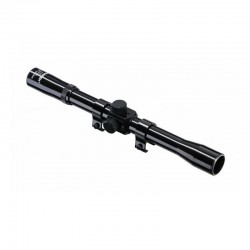
Umarex 4x20 Scope
via DAI Leisure
£19.95
Buying Advice
The .308 generates moderate recoil — most quality scopes handle it without issue, including budget Chinese-made glass. However, if you're mounting on a semi-auto or if you fire extended strings in PRS competition, look for scopes that have been recoil-rated. Premium brands publish recoil resistance figures; Vortex, Leupold, and Nightforce all publish confidence-inspiring specs.
Consider your turret style. For stalking where you set and forget your zero, capped turrets protect the zero from accidental nudges. For range work or PRS where you dial corrections, exposed tactical turrets with a zero-stop are far more practical.
Frequently Asked Questions
What magnification do I need for a .308 scope?
For deer stalking with .308, a 3–12× or 3–15× covers all realistic UK field shots. For long-range target shooting to 1,000 yards, a 4–24× or 6–24× is more appropriate. If you do both, a versatile 4–16× or 4–20× is a practical compromise that avoids carrying two rifles.
What is the best budget scope for a .308 in the UK?
The Vortex Diamondback Tactical 4–16×44 FFP and the Hawke Sidewinder 30 SF 6–24×50 FFP are strong performers under £400 in the UK market. Both offer side focus, zero-reset turrets, and illuminated reticles suited to range work. For a hunting-oriented setup under £300, the Vortex Crossfire II 3–9×40 or Nikko Stirling Panamax 3–9×40 are reliable entry-level choices.
Can I use the same scope for deer stalking and target shooting with .308?
Yes, but it requires compromises. A medium-range variable like a 4–16×44 or 3–15×50 gives enough magnification for target work while remaining practical in the field. For best results at both ends, many shooters keep two setups — a dedicated stalking scope (lower power, quality glass, German reticle) and a target scope (high magnification, MRAD turrets, FFP).
What reticle is best for .308 long-range shooting?
For long-range work, a mil-dot, Horus H59, or Christmas-tree MRAD reticle in FFP gives the most flexibility — you can hold for wind and elevation without dialling. For hunting or mixed use, a simple illuminated duplex or BDC reticle calibrated for .308 (some manufacturers offer .308-specific BDC cams) is quicker in the field.
What is the maximum effective range of .308 Winchester?
In practical UK conditions with standard 168-grain match ammunition, .308 remains supersonic to around 900–1,000 yards. The trans-sonic transition (typically around 1,350 fps) at these distances causes instability and unpredictability. Most serious .308 shooters consider 800 yards a practical maximum for consistent precision shooting, though 1,000-yard records are regularly shot in calm conditions.
Related guides
Find the best scope for 30-30 lever actions in 2026. Expert picks for Marlin 336, Henry, and Winchester 94 rifles…
Best Scopes for .243 Winchester UK 2026Find the perfect scope for your .243 Winchester rifle in the UK. Deer stalking, varminting and long-range picks…
Best Budget Scopes Under £200 UK 2026The best rifle scopes under £200 in the UK — reliable, clear glass for air rifles, rimfire, and centre-fire use.
Best Mid-Range Scopes Under £500 UK 2026The best rifle scopes between £200 and £500 in the UK — the sweet spot for serious hunters, stalkers, and range shooters.
Not sure which scope is right for you?
Try our AI-powered scope finder — answer a few questions and get personalised recommendations.
Find My Scope →Get a UK scope tip every day
Follow AiScopes on Facebook for daily buying guides, deals and gear advice.
Follow on Facebook